
Istanbul trips · Sultanahmet
Sultanahmet in One Day: From Hagia Sophia to the Hippodrome
There are six stops you should see in Sultanahmet in one day: Hagia Sophia, Topkapı Palace, the Basilica Cistern, the Istanbul Archaeology Museums, the Blue Mosque (Sultan Ahmed Mosque) and the Hippodrome. They are all within walking distance of one another. If you devote the morning to Hagia Sophia, Topkapı and the Basilica Cistern, and the afternoon to the Archaeology Museums, the Blue Mosque and the Hippodrome, you can explore the heart of the historic peninsula in a single day without rushing.
Why this order?
When visiting Sultanahmet, the real time is lost at ticket offices and security checks. Going to the most visited places, such as Topkapı Palace and Hagia Sophia, early in the morning makes the rest of the day easier. In the afternoon you visit the quieter Archaeology Museums and the open spaces of the Hippodrome and the area around the mosque. This order also lets you see Byzantium and the Ottomans side by side throughout the day.
Morning: from Byzantium to the Ottoman palace
Hagia Sophia
Built in the reign of the Byzantine Emperor Justinian I, Hagia Sophia was one of the largest churches in the world for centuries. After the conquest it was converted into a mosque, it was used as a museum in the Republican period, and today it is again open for worship as a mosque. With its enormous dome, marble-clad walls and mosaics visible in places, it is a building where two great civilisations meet in the same space.
Visiting rules and the sections open to visitors may change from time to time. Visits are restricted during prayer times, and you need to follow the mosque's dress rules.
Topkapı Palace
The palace, where the Ottoman sultans lived and ran the state for centuries, stands at Sarayburnu, overlooking the point where the Bosphorus, the Golden Horn and the Sea of Marmara meet. The courtyards are visited in order, each one opening onto a more private area than the one before. The Imperial Council (Divan-ı Hümayun), the Treasury, the Chamber of the Sacred Relics and the kitchens are the main sections. The Harem is organised as a separate visiting section.
Because the palace covers a large area, seeing all of it takes a long time. Touring with a guide helps you decide which sections to prioritise.
Basilica Cistern
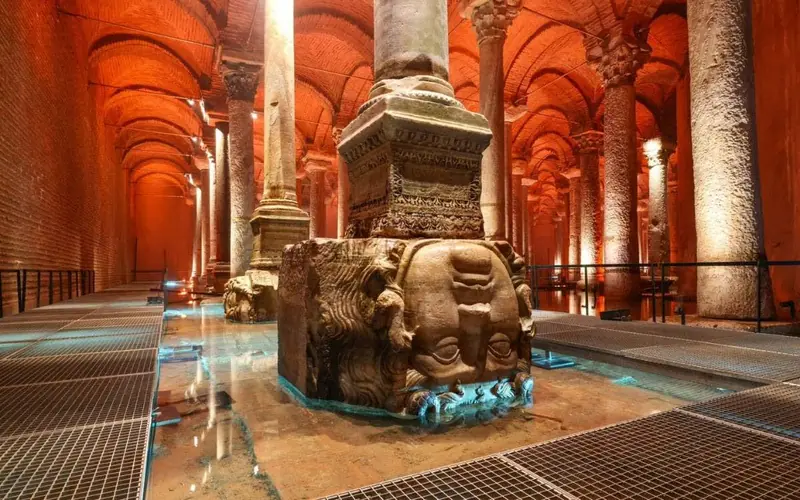
Built in the Byzantine period to meet the city's water needs, this underground cistern is a mesmerising space where hundreds of columns rise from the water in dim light. The details that attract the most attention are the two Medusa heads used as column bases. On hot summer days, its cool air is a welcome relief.
Lunch break
The morning programme is busy; there are plenty of options for lunch in and around Sultanahmet. One of the area's well-known specialities is köfte (meatballs). If you are coming as a group, planning the meal break in advance saves time at busy hours.
Afternoon: museums and the square
Istanbul Archaeological Museums
Located in the outer garden of Topkapı Palace, near Gülhane Park, this museum complex is made up of the Archaeology Museum, the Museum of the Ancient Orient and the Tiled Kiosk. The most famous piece in the museum, founded under the leadership of Osman Hamdi Bey, is the marble sarcophagus known as the Alexander Sarcophagus, found in Sidon. The tablet of the Treaty of Kadesh is also counted among the museum's most important pieces.
It is a good stop for exploring in a calmer atmosphere after the crowded museums. For student groups, it is very rich in concrete examples of lesson topics about ancient times.
Blue Mosque (Sultan Ahmed Mosque)
Rising opposite Hagia Sophia and known for its six minarets, the Sultan Ahmed Mosque was built in the reign of Ahmed I. Because of the blue İznik tiles decorating its interior, it is also known among foreign visitors as the "Blue Mosque". As it is a working mosque, visits are paused during prayer times.
Hippodrome
The Hippodrome, where chariot races were held in the Byzantine period and which was the centre of the city's social life, is known today as Sultanahmet Square. Three monuments await you in the square:
- The Egyptian Obelisk (Dikilitaş): An obelisk brought from Egypt and decorated with ancient Egyptian hieroglyphs.
- The Serpent Column: A bronze column, known to have been brought from ancient Greece, resembling the intertwined bodies of snakes.
- The Walled Obelisk: A monument built of stacked stones, also known as the Column of Constantine.
The German Fountain at one end of the square is also a popular spot for photos.
Touring with a guide
The Sultanahmet Tour is a guided programme of about 8 hours that follows this order. Departure is at 08:30; at 10:00 you visit Hagia Sophia, Topkapı Palace and the Basilica Cistern. At 13:00 there is a lunch break (listed as an extra in the catalogue). At 14:30 the programme is completed with the Istanbul Archaeology Museums, the Blue Mosque and the Hippodrome. Since the stops are within walking distance, time goes on sightseeing rather than transport. Museum entrance fees and options such as the Museum Pass vary with the date of the visit and the make-up of the group, so they are stated separately in the quote.
You can find our other day trips in Istanbul on our Istanbul City Tours page.
Practical tips
- You will walk a lot during the day; wear comfortable shoes.
- In mosques, women need a headscarf and everyone needs clothing that covers the knees and shoulders. Carrying a shawl makes things easier.
- There are security checks at the museums and the palace; large bags slow you down.
- Bring water and a hat in summer, and a raincoat in winter.
Frequently asked questions
What are the places to visit in Sultanahmet?
The main sights are Hagia Sophia, Topkapı Palace, the Basilica Cistern, the Istanbul Archaeology Museums, the Blue Mosque (Sultan Ahmed Mosque) and the Hippodrome. They are all within walking distance of one another.
Can you see Sultanahmet in one day?
Yes. If you devote the morning to Hagia Sophia, Topkapı and the Basilica Cistern, and the afternoon to the Archaeology Museums, the Blue Mosque and the Hippodrome, you can see the main stops in one day.
Are museum entrance fees included in the Sultanahmet tour?
Entrance fees and options such as the Museum Pass vary with the date of the visit and the make-up of the group, so they are stated separately in the quote. Lunch is listed as an extra in the catalogue.
Is Sultanahmet suitable for a school trip?
Yes. It is directly linked to history, social studies and art lessons, and it lets students compare Byzantine and Ottoman buildings on the same day.