International · CERN
What Is CERN? Geneva, Toulouse and the Cities on the Science Route
CERN is an international physics laboratory on the Swiss-French border near Geneva that investigates the most fundamental building blocks of matter; it is home to the Large Hadron Collider, known as the world's largest particle accelerator. Toulouse, home to Airbus headquarters, is one of the key cities of the European aerospace industry. On a trip linking these two cities, Montpellier, Avignon and Lyon along the way add history and culture to the route.
CERN: exploring the smallest pieces of the universe
A brief history
CERN was founded in 1954 to revive scientific cooperation in Europe after the Second World War. The acronym comes from the French name of its founding council. Today it is a centre supported by many member states, where researchers from all over the world work. Türkiye is one of CERN's associate members.
The Large Hadron Collider (LHC)
CERN's best-known facility is the Large Hadron Collider, housed in a circular tunnel about 27 kilometres long underground. Here protons are accelerated to speeds very close to the speed of light and made to collide. The particles produced by the collisions are studied with giant detectors such as ATLAS and CMS.
The Higgs boson
In 2012, experiments at CERN announced the discovery of the Higgs boson, whose existence had been predicted decades earlier. This particle is linked to the mechanism that explains how other particles acquire mass. The discovery was crowned the following year with the Nobel Prize in Physics, awarded to the scientists who proposed the theory.
The birthplace of the Web
The World Wide Web, which we use every day, was proposed in 1989 by Tim Berners-Lee, then working at CERN, to make it easier for scientists to share information. The story is a fine example of how basic research can change daily life in unexpected ways.
About visiting
CERN is an institution that cares about explaining science to visitors through public exhibitions and educational activities. Group visits, however, depend on its booking, capacity and security rules, and what can be seen may vary from period to period. On our tour, the scope of the visit is confirmed once the date is fixed and stated in the quote.
Geneva: diplomacy and the lakeshore
Geneva sits at the south-western tip of Lake Geneva (Léman) and is known for its international organisations.
- Jet d'Eau: The giant fountain rising from the middle of the lake is the city's symbol.
- Old town: Cobbled streets and St Pierre Cathedral.
- United Nations: One of the UN's main offices in Europe is in Geneva. The broken-legged chair sculpture in front of it also catches the eye.
- Red Cross: Geneva is known as the birthplace of the international Red Cross movement.
Switzerland's currency is the Swiss franc, a practical detail to keep in mind when coming over from France.
Toulouse: the "Pink City" and aviation
Toulouse is known as the "Pink City" (La Ville Rose) because of the pinkish-red bricks used in its buildings. Set on the banks of the Garonne, it is a lively university city.
Toulouse's modern identity is tied to aviation. Airbus is headquartered here, and the area around the city is home to many organisations linked to the aircraft and space industry. The city also has a space-themed science park (Cité de l'espace); we work out together at the quote stage whether extra visits like this can be added to the programme.
In the historic centre you can see the Capitole square and the Basilica of Saint-Sernin, considered one of the finest examples of Romanesque architecture.
Other cities on the route
Montpellier
Montpellier, where the route begins, is a university city near the Mediterranean with a young population. Its tradition of medical education goes back a very long way. The wide Place de la Comédie and the narrow streets of the old town are best explored on foot.
Avignon
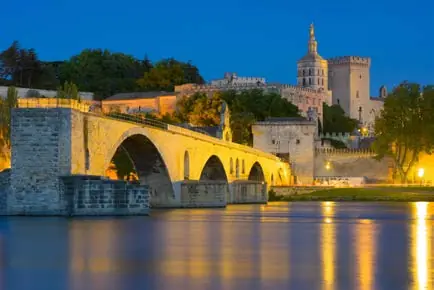
Avignon was for a time the seat of the papacy in the 14th century. The magnificent Palace of the Popes from this period and the Pont Saint-Bénezet (Avignon Bridge), famous for its unfinished span over the Rhône, are the city's symbols. Its historic centre is on the UNESCO World Heritage List.
Lyon
Lyon, with roots going back to Roman times, is one of France's historic cities. The basilica and Roman theatre on Fourvière hill, the "traboules" (hidden passageways) of the old town (Vieux Lyon) and its gastronomic tradition are among its highlights. As the city of the Lumière brothers, pioneers of cinema, it also makes a fitting end to a science and technology route.
What to read before you go
A little reading beforehand goes a long way in getting the most out of this route. Popular science books introducing particle physics, documentaries about the discovery of the Higgs boson and simple resources on the physics of flight are a good start. On the French side, reading a few pages about the papal era in Avignon and Lyon's Roman past makes the city stops more meaningful too. For student groups, these readings can also be the topics of presentations before the trip.
The route as a whole
The CERN and Airbus Tour is a 4 nights, 5 days programme with accommodation. The route begins in Montpellier, the second day is devoted to Toulouse, on the third day you travel via Avignon to Geneva, and the fourth day is spent in Geneva. The return is via Lyon. The programme suits school, youth and corporate groups.
If you are going with a student group, we explain the preparation step by step in our article CERN and Airbus science trip planning guide.
Frequently asked questions
What does CERN do?
CERN is an international physics laboratory that investigates the most fundamental building blocks of matter and the forces that hold them together. To do this, it uses particle accelerators and giant detectors.
Which country is CERN in?
CERN is near Geneva, on the border between Switzerland and France. Some of its facilities are in Switzerland and some on French soil.
Can anyone visit CERN?
CERN holds exhibitions and events for visitors, but group visits depend on its booking, capacity and security rules. Check the current conditions on the institution's official sources.
Do you need a visa for this route?
The route passes through France and Switzerland. As visa and passport requirements change, check the current situation with the official sources of the countries concerned and the Turkish Ministry of Foreign Affairs before travelling.