
International · Egypt
Places to Visit in Egypt: Cairo, Giza, Saqqara and Luxor
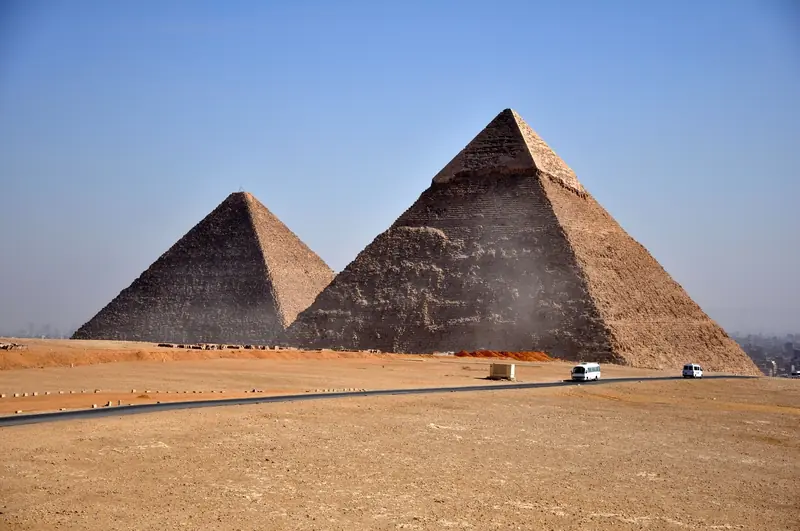
If you are going to Egypt for the first time, the must-see places are concentrated in two centres: Cairo and its surroundings (the Giza pyramids and the Sphinx, the Step Pyramid of Djoser at Saqqara, Islamic Cairo, the Khan el-Khalili bazaar and the great museums displaying antiquities) and Luxor, further up the Nile (the Karnak and Luxor temples, the Valley of the Kings, the Temple of Hatshepsut and the Colossi of Memnon). A five- or six-day route combining these two cities covers most of the best-known monuments of ancient Egypt.
Below we describe each stop, along with why you should see it.
Cairo and around
The Giza pyramids and the Sphinx
On the Giza plateau, on the western edge of Cairo, three great pyramids stand side by side: Khufu (the Great Pyramid), Khafre and Menkaure. Known as the only one of the seven wonders of the ancient world still standing, the Great Pyramid amazes you up close with the sheer size of its stone blocks. Just below it, the Sphinx, a giant statue with a lion's body and a human head, is the plateau's second symbol. We explain how to visit Giza in detail in our guide to visiting the Giza pyramids.
Saqqara and the Step Pyramid of Djoser
South of Giza, Saqqara is the great necropolis of Memphis. Its Step Pyramid of Djoser is considered one of the oldest known monumental stone structures and is important for understanding how pyramid architecture developed: before smooth-sided pyramids, builders began with steps stacked on top of each other. As it is quieter than Giza, it gives visitors a breather.
Islamic Cairo and Khan el-Khalili
Cairo is not only about antiquity. In the historic centre, mosques, madrasas and gates from the Fatimid, Mamluk and Ottoman periods stand close together. At the heart of this area, Khan el-Khalili is a bazaar that has been trading for centuries: copperwork, lamps, spices, hookah cafés and narrow passages. The bazaar is livelier in the evening.
Museums displaying Egyptian antiquities
Cairo has large museums displaying ancient Egyptian artefacts, where you can see pharaohs' statues, mummies, grave goods and jewellery. Seeing a museum before going to the temples and tombs makes it easier to make sense of what you see afterwards.
Luxor
Luxor, known in antiquity as Thebes, was Egypt's religious and political centre in the New Kingdom period. The Nile divides the city in two: the east bank was seen as the bank of the living and the west bank as the bank of the dead. This division still shapes how you plan your visit today. You can find how to see Luxor day by day in our Luxor travel guide.
East Bank: the Karnak and Luxor temples
- Karnak Temple: A vast temple complex that grew over centuries with additions by different pharaohs. Its hypostyle hall, like a forest of columns, is the most impressive part.
- Luxor Temple: Located in the city, close to the Nile. When lit up in the evening, it takes on a beauty of its own. The Karnak and Luxor temples were once linked by an avenue lined with sphinxes.
West Bank: the Valley of the Kings and around
- Valley of the Kings: The valley containing the rock-cut tombs of the New Kingdom pharaohs. Tutankhamun's tomb is here too. The colourful paintings and hieroglyphs on the tomb walls are still vivid thousands of years later.
- Temple of Hatshepsut: A temple instantly recognisable by its terraces set against the cliffs. It was built for Hatshepsut, the female ruler who governed Egypt as pharaoh.
- Colossi of Memnon: Two giant statues seated among the fields at the entrance to the West Bank. Worth seeing even for a short photo stop.
How to plan the route
Between Cairo and Luxor you take a domestic flight or a sleeper train. TatiliYakala's Egypt tour: Cairo and Luxor programme is planned as 5 nights, 6 days with the following schedule:
- Flight from Istanbul to Cairo, evening walk in Islamic Cairo and Khan el-Khalili.
- The Giza pyramids and the Sphinx, then the Step Pyramid of Djoser at Saqqara in the afternoon.
- Museum visit in Cairo, evening transfer to Luxor by domestic flight or sleeper train.
- Luxor East Bank: the Karnak and Luxor temples, free time on the Nile waterfront in the evening.
- Luxor west bank: the Valley of the Kings, the Temple of Hatshepsut and the Colossi of Memnon.
- Return from Luxor to Istanbul via Cairo.
This programme is a new route not in the catalogue; we confirm the details with you at the quote stage. If you have not yet decided when to go, our article on when to go to Egypt can help.
For visa and entry requirements, check the current situation with Egypt's official sources and the Turkish Ministry of Foreign Affairs before you travel.
A few tips for your trip
The ancient sites in Egypt are large and shadeless; keep a hat, sunglasses and water with you at all times. At temples and tombs, some sections may be closed for conservation, so do not assume a site will always be visited in the same way.
Frequently asked questions
What is the one place you must see in Egypt?
The Giza pyramids and the Sphinx top the list for most travellers. But Karnak Temple and the Valley of the Kings in Luxor are at least as impressive; if possible, plan to see both.
How do you get between Cairo and Luxor?
A domestic flight or an overnight sleeper train are the two most common options. The flight is faster, while the train offers an experience that takes the place of a hotel night.
How many days do you need in Egypt?
Five or six days is a reasonable length to see Cairo and Luxor together. Those who want to add Aswan, a Nile cruise or the Red Sea coast will need more time.
Is Cairo enough on its own, without Luxor?
Cairo, Giza and Saqqara alone make for a rewarding trip. But without the temples and pharaohs' tombs, the picture of ancient Egypt is incomplete, so we recommend adding Luxor.