Domestic · Safranbolu
Places to Visit in Safranbolu: Mansions, Bazaars and Hıdırlık Hill
Most of the places to visit in Safranbolu are within walking distance of one another in the old centre known as Çarşı: the view from Hıdırlık Hill, the Kaymakamlar House, Cinci Han, the İzzet Mehmet Paşa and Köprülü Mehmet Paşa mosques, and the Yemeniciler Arasta. The town's Ottoman-era fabric is on the UNESCO World Heritage List. The second day of our Safranbolu and Amasra tour is devoted entirely to these stops.
What makes Safranbolu special?
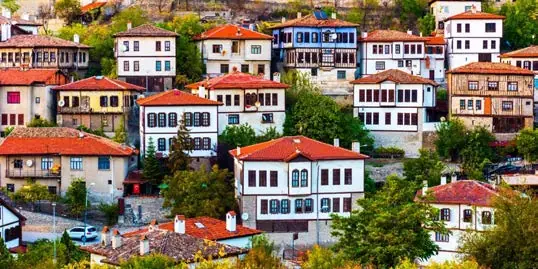
While old houses in many Anatolian towns have been lost among new buildings, Safranbolu has preserved its Ottoman urban fabric as a whole. Whitewashed mansions with projecting wooden upper floors, narrow cobbled streets, inns, hammams and mosques all stand together. This integrity is the reason the town was added to the UNESCO World Heritage List in 1994.
Another feature of Safranbolu is that two separate settlements were traditionally used. In winter people lived in the Çarşı area in the valley, and in summer in the vineyard houses higher up. Today, the area most travellers explore is Çarşı, where the winter houses stand.
Hıdırlık Hill
Starting the day on Hıdırlık Hill is the easiest way to understand the town. From the top, the red-tiled roofs of the old neighbourhoods, the minarets rising between them and the shape of the valley all appear in a single frame. This view immediately explains why the town feels so well preserved. It is also one of the most popular spots for photos.
Clock Tower
The historic Clock Tower, standing on a slope overlooking Çarşı, dates from the Ottoman period and is one of the town's symbols. There is also a lovely view of the town from around it.
Bazaars: Drapers', Coppersmiths', Blacksmiths'
Safranbolu's old bazaar is made up of streets divided by trade. In the Coppersmiths' Bazaar you can hear copper being hammered, and in the Blacksmiths' Bazaar you can watch traditional tools being made. These bazaars are living examples of the town's centuries-old craft tradition.
İzzet Mehmet Paşa Mosque
Built by İzzet Mehmet Paşa, one of the Ottoman grand viziers, the mosque is among the largest in the town centre. With its courtyard and dome, it holds a prominent place in the Çarşı skyline.
Köprülü Mehmet Pasha Mosque and its sundial
In the courtyard of the 17th-century Köprülü Mehmet Paşa Mosque, what draws visitors most is a stone sundial. Telling the time by the sun's shadow, it shows how time was measured in an age when mechanical clocks were not common.
Cinci Han
Cinci Han, one of Safranbolu's best-known buildings, was built as a caravanserai in the 17th century. With its thick stone walls and inner courtyard, it is a classic Ottoman inn. On our tour, Cinci Han is seen as a panoramic stop, that is, from the outside.
Kaymakamlar House
To see the inside of a Safranbolu mansion, the stop on our tour is the Kaymakamlar House. Arranged as a museum, the house shows how life was lived in a traditional Safranbolu mansion. Things to look out for inside:
- Haremlik and selamlık: The parts of the house set aside for women and for guests.
- Cupboard bathroom: A small washing area hidden inside the built-in cupboard of a room.
- Revolving cupboard: A rotating shelf between the kitchen and the room for passing food and objects without coming face to face.
- Divans and ceiling decorations: The seating that runs along the walls of the rooms and the carved wooden ceilings.
In most mansions you notice that each room was designed almost as a self-contained living space: sitting, eating and sleeping all took place in the same room.
Yemeniciler Arasta
The Yemeniciler Arasta, once the bazaar of the craftsmen who made the traditional leather shoes called "yemeni", is now full of handicraft and souvenir shops. On our tour there is time for shopping here and a Turkish delight break. We describe what you can buy in the arasta in detail in our article on Safranbolu and Amasra flavours.
Yörük Köyü
Yörük Village, near Safranbolu, is the first stop on the third day of our tour. In the village you will see the Sipahioğlu Mansion and the historic laundry house shared by the villagers. The village's cobbled streets and mansions show the rural life of Safranbolu. There is also a short period of free time here.
The Bağlar district
The Bağlar district, where Safranbolu's summer houses stand, is a greener settlement with larger gardens than Çarşı. It is not part of our tour programme, but it is worth knowing about to understand the town's two-season way of life.
Exploring Safranbolu with children
Children usually find the revolving cupboard and the hidden cupboard bathroom in the Kaymakamlar House fascinating. The sundial at the Köprülü Mehmet Paşa Mosque is also a great chance for a "let's read the time" game. The cobbled streets can be hard going with a pushchair; a baby carrier is more practical for small children.
Things to keep in mind while sightseeing
- The streets of Çarşı are cobbled and steep in places. Wear comfortable shoes.
- Some of the mansions are still used as homes or guesthouses. Do not enter private areas.
- In museum houses such as the Kaymakamlar House, the wooden floors and stairs are delicate; move around slowly and carefully.
- For photos, early morning and late afternoon light makes the streets look far more beautiful.
Frequently asked questions
How many days should you stay in Safranbolu?
The main sights of the Çarşı area can be seen in a full day. On our tour, day two is devoted to Safranbolu and the morning of day three to Yörük Village.
Why is Safranbolu on the UNESCO list?
It was added to the UNESCO World Heritage List in 1994 because it has preserved its Ottoman-era urban fabric as a whole, with its mansions, bazaars and mosques.
Which mansion can you visit in Safranbolu?
On our tour, we visit the Kaymakamlar House, which is arranged as a museum. In Yörük Village, we visit the Sipahioğlu Mansion.
Can you go inside Cinci Han?
In the programme, Cinci Han is seen as a panoramic stop, that is, from the outside.