International · Benelux
Things to See in Benelux, Paris and Cologne: A City-by-City Guide
Here is the shortlist for each city on the Benelux and Paris route: the Grand-Place in Brussels, the canals and the Markt in Bruges, the canal ring and museums in Amsterdam, the giant cathedral on the Rhine in Cologne, the walled old town in Luxembourg, and in Paris the Eiffel Tower, the area around the Louvre and the banks of the Seine. As these cities are close together, it is possible to combine five countries in a short programme. Below you will find what to prioritise at each stop.
Brussels: the city seen as Europe's capital
As it hosts the institutions of the European Union, Brussels is often called "the capital of Europe". But what stays in visitors' minds is its historic centre.
- Grand-Place: Surrounded by ornate guildhalls and the town hall, the square is known as one of the most impressive in Europe. It takes on a special beauty when lit up in the evening.
- Manneken Pis: The city's small but very famous bronze statue. Many people are surprised when they see its size.
- Atomium: Designed as an enlarged model of an iron crystal, this giant structure is the city's modern symbol.
Don't leave Brussels without trying waffles, chocolate and chips. Belgium is famous for all three.
Bruges: canals and the Middle Ages
Bruges is a small city ringed by canals that has largely preserved its medieval fabric. Its historic centre is on the UNESCO World Heritage List.
- Markt: Here you will find houses with colourful façades and the belfry (Belfort), the symbol of the city.
- Canals: A short boat trip on the canals is an enjoyable way to see the city from a different angle.
- Begijnhof: A peaceful corner with white houses and a quiet garden.
Bruges is small; you can see most of the historic centre in a walk of a few hours.
Amsterdam: canals, bikes and museums
Amsterdam's canal ring is the city's postcard image. Narrow, tall houses, bridges and bikes parked everywhere give the city its character.
- Canal cruise: One of the most practical ways to see the city from the water.
- Rijksmuseum: Masterpieces of Dutch painting, such as Rembrandt's The Night Watch and works by Vermeer.
- Van Gogh Museum: The painter's works, known as one of the largest collections in the world.
- Anne Frank House: One of the most moving testimonies of the Second World War. Visits require advance planning.
- Dam Square and the Jordaan: The city centre and one of its best-loved neighbourhoods.
When walking in Amsterdam, watch out for cycle lanes: cyclists are fast, and walking in a cycle lane can be dangerous for pedestrians.
Cologne: a cathedral on the Rhine
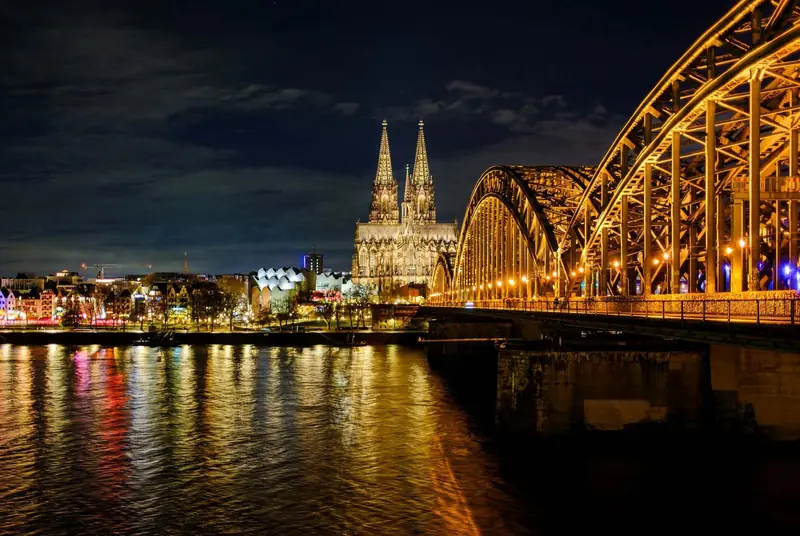
The symbol of Cologne is Cologne Cathedral, rising on the banks of the Rhine right next to the railway station. Regarded as one of the most impressive examples of Gothic architecture, it is on the UNESCO World Heritage List. Its construction took centuries and was completed in the 19th century.
As well as the cathedral, the riverside promenade along the Rhine and the Hohenzollern Bridge, known for its love locks, are enough for a short stop.
Luxembourg: small but impressive
Luxembourg is one of the smallest countries in Europe. The capital's old town and fortifications are on the UNESCO World Heritage List. In this city built above deep valleys, looking down from the walls onto the Grund quarter below is the highlight of a visit. The old defensive tunnels carved into the rock (the Bock Casemates) reveal the city's military past.
Paris: priorities for a first visit
You can't see everything in Paris in a few days, but you can reach the highlights:
- Eiffel Tower: Impressive both up close and seen from the Trocadéro.
- Louvre: The vast museum that is home to the Mona Lisa. Even the glass pyramid outside is a stop in itself.
- Notre-Dame and the Île de la Cité: The historic core of Paris.
- Champs-Élysées and the Arc de Triomphe: The city's best-known avenue.
- Montmartre and Sacré-Cœur: Known for its view over the city from the hill and its square full of painters.
- Banks of the Seine: A walk along the river or a boat trip.
When one day of the Paris route is set aside for Disneyland, this list gets even shorter. We explain how to prepare for the Disneyland day in our Disneyland Paris family guide.
Flavours along the way
This route is also varied in terms of food. Waffles, chocolate and chips in a paper cone in Belgium; thin caramel stroopwafels sold at street stalls and cheeses in the Netherlands; German sausages and baked goods in Cologne; and croissants, baguettes and café culture in Paris. Trying a local speciality even on short stops helps you tell the cities apart.
Seeing these cities on one route
The Benelux, Paris and Germany Tour is a 5-night, 6-day programme. After arriving in Brussels, you travel via Bruges to Amsterdam, and on the third day via Cologne to Luxembourg. On the fourth day you reach Paris, the fifth day is set aside for Disneyland, and the return is via Luxembourg.
We finalise the intensity of the programme and how much time to spend at each stop together at the quote stage. Our article When to visit Benelux can also help you choose the season.
Frequently asked questions
How much time is enough in Bruges?
As the historic centre is small, a walk of a few hours is enough to see the main sights. If you add a canal trip, allow a little more time.
Do you need to plan ahead for museums in Amsterdam?
The Rijksmuseum, the Van Gogh Museum and especially the Anne Frank House are in high demand, so you need to plan your visits in advance.
How much time should you allow to see Cologne Cathedral?
A short stop is enough to see the cathedral inside and out. As it is next to the railway station, it is also easy to reach.
Do you need a visa for this route?
Visa and passport conditions can change. Before travelling, check the current situation with the official sources of the countries concerned and the Ministry of Foreign Affairs of the Republic of Türkiye.